

The Roscoe Library has a book club, Reading with Spiritual Eyes, based on works of fiction. Aligning with school terms, we explore four (sometimes five!) books per year. Generic questions are provided below which assist with our discussions, and additional ones are used when helpful. Toward the end of term, we gather at the Roscoe Library to discuss our insights and share refreshments. If you’re not able to be with us in person, you’re invited to join us via Zoom. All are welcome, but please register for set-up purposes or to receive the zoom link.
On 16 June 2026, from 5:30pm — 7:00pm, we are gathering to discuss The Correspondent: A Novel by Virginia Evans.
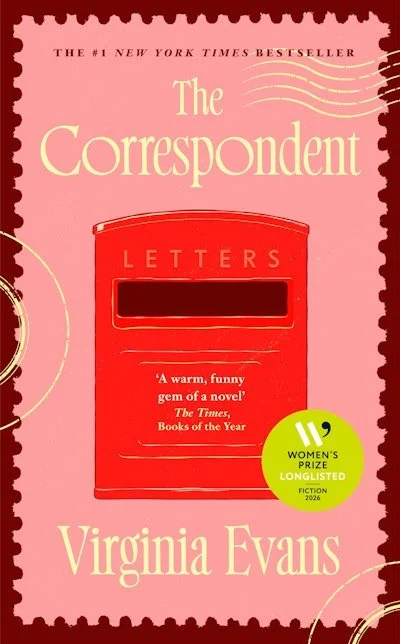
The Correspondent: A Novel
84 Charing Cross Road meets A Man Called Ove in this heartwarming, witty story about the life of an extraordinary woman, told through her letters.
In her letters to family and friends we come to know the life of Sybil Van Antwerp: stubborn, cantankerous, opinionated, always steadfast in her belief in the power of the written word.
But as the clock begins to tick for Sybil, the need for a few post-scripts to the life she’s led becomes apparent. Fixing her difficult relationship with her children. Taking a final chance at romance. Atoning for an old legal case which has come back to haunt her. And finally, reckoning with a devastating loss that she has spent the last thirty years holding close to her chest.
Author Information
Virginia Evans attended James Madison University for her bachelor’s in English literature. After starting a family, she went back to school for her master’s of philosophy in creative writing at Trinity College in Dublin, Ireland, where she had the good fortune to study under Carlo Gébler, Eoin McNamee, Claire Keegan, Harry Clifton and Kevin Power. She now lives in Winston-Salem, North Carolina, with her husband, Mark, two children, Jack and Mae, and her Red Labrador, Brigid.
We meet once per term on a Tuesday from 5:30pm - 7:00pm. Mark your calendars now for our other 2026 dates: 8 September and 17 November.
Questions you may choose to guide your group’s discussion …
Is this a book that you would have chosen to read had it not been suggested by this book club?
Do you identify strongly with any of the main characters and, if so, why?
How do you feel the characters responded to the situations with which they were presented?
Did you find this book related to any of your own life experiences?
What key events stood out to you, and why?
Where is God in this book?
Do you consider that this book provides opportunities for spiritual growth and reflection?
Are there any theological themes present? If so, what did you think of their use?
What, if anything, did you find confronting?
How did you feel about the ending of the book? Satisfied? Frustrated? Irritated? Disappointed? Inspired?
To whom would you recommend this book?
What else have we read? These can be borrowed from the Roscoe Library.
Term 1 2026: Comes the Night by Isobelle Carmody
Term 4 2025: Stone Yard Devotional by Charlotte Wood
Term 3 2025: The Bell of the World by Gregory Day
Term 2 2025: James by Percival Everett
Term 1 2025: The Sitter by Angela O’Keeffe
Term 0 2025: Let’s Talk Books!
Term 4 2024: Chai Time at Cinnamon Gardens by Shankari Chandran
Term 3 2024: The Labyrinth by Amanda Lohrey
Term 2 2024: One Illumined Thread by Sally Colin-James
Term 1 2024: The Fire and the Rose by Robyn Cadwallader
Term 0 2024: Enter Ghost by Isabella Hammad
Term 4 2023: Limberlost by Robbie Arnott
Term 3 2023: Black Butterflies by Priscilla Morris
Term 2 2023: For Thy Great Pain Have Mercy on My Little Pain by Victoria Mackenzie
Term 1 2023: Bruny by Heather Rose
Term 0 2023: Carpentaria by Alexis Wright
Term 4 2022: Joan: A Novel by Katherine J. Chen
Term 3 2022: Abomination by Ashley Goldberg
Term 2 2022: The Colony by Audrey Magee
Term 1 2022: Still Life by Sarah Winman
Term 4 2021: Before the Coffee Gets Cold by Toshikazu Kawaguchi
Term 3 2021: Klara and the Sun by Kazuo Ishiguro
Term 2 2021: The Dictionary of Lost Words by Pip Williams
Term 1 2021: The Living Sea of Waking Dreams by Richard Flanagan
Term 4 2020: A Room Made of Leaves by Kate Grenville
Term 3 2020: The Yield by Tara June Winch
Term 2 2020: Apeirogon: A Novel by Colum McCann
Term 1 2020: The Mercies by Kiran Millwood Hargrave
Term 4 2019: You Will Be Safe Here by Damian Barr
Term 3 2019: Taboo by Kim Scott
Term 2 2019: The Freedom Artist by Ben Okri
Term 1 2019: Shell by Kristina Olsson
Term 4 2018: Boy Swallows Universe by Trent Dalton
Term 3 2018: Book of Colours by Robyn Cadwallader
Term 2 2018: The Immortalists by Chloe Benjamin
Term 1 2018: Home Fire by Kamila Shamsie
Term 4 2017: The Barrier by Shankari Chandran
Term 3 2017: A Man Called Ove by Fredrik Backman
Term 2 2017: A Hundred Small Lessons by Ashley Hay
Term 1 2017: The Museum of Modern Love by Heather Rose
Term 4 2016: Tell the Truth, Shame the Devil by Melina Marchetta
Term 3 2016: Everyone Brave is Forgiven by Chris Cleave
Why bother reading fiction?
Alison Sampson captures the essence of why we believe reading fiction adds value to people’s lives when she writes:
“Why read fiction? It’s often thought of as an escape, and sometimes it is; but good fiction is much more than that. A well-crafted story takes you into the mind of another; it gives you a different perspective; it holds up a mirror to yourself; it reveals the society we live in; it invites the reader to find compassion, or possibility, or hope.
… Unless we make conscious decisions to spend time with all sorts of people, we can easily assume that our way of life is the norm; other lives become invisible. Worse, when everything is going swimmingly, we can become complacent, even cruelly indifferent, towards others whose lives are not so easy.
A good piece of fiction is a powerful antidote. Immersed in a story, I find myself living another life. I might get a glimpse of what it is like to work alone at night, or lose a child, or have a differently wired brain. I might see, for a moment, through the eyes of a sex worker, or an asylum seeker, or a lowly hospital orderly who must exercise a moral choice. I might recognise myself in a story, and find it challenging.
When I raise my eyes from the page, things look a little different: sometimes bigger, sometimes bleaker, sometimes more hopeful. My place in the world shifts, too, because when I see through the eyes of another as I read, it becomes easier to see through the eyes of those I encounter every day; when I recognise myself in a story, I may feel compelled to live differently. A really good book can help heal my heart of stone, show me the path to compassion, and stir me into love.” [Alison Sampson, “A Good Book Can Stir Us into Love,” Zadok Perspectives, no. 121 (2013): 3.]
Chris Glaser suggests reading as one way of experiencing spiritual community outside of church in an article Spiritual Community:
“I enjoy the most diverse, stimulating, informed, and wise spiritual community on my bookshelves! Fiction and non-fiction, sacred and profane, fantasy and factual—you name it, all connect me to other people, places, and things with whom and with which I may feel a spiritual kinship. Newspaper and magazine human interest stories, op-eds, obits, and news stories also open me to relationships often more spiritually intimate than possible in ordinary life. All are opportunities for witnessing spirituality at work for those who have eyes to see, fingers to feel Braille, or ears to hear recorded versions.”